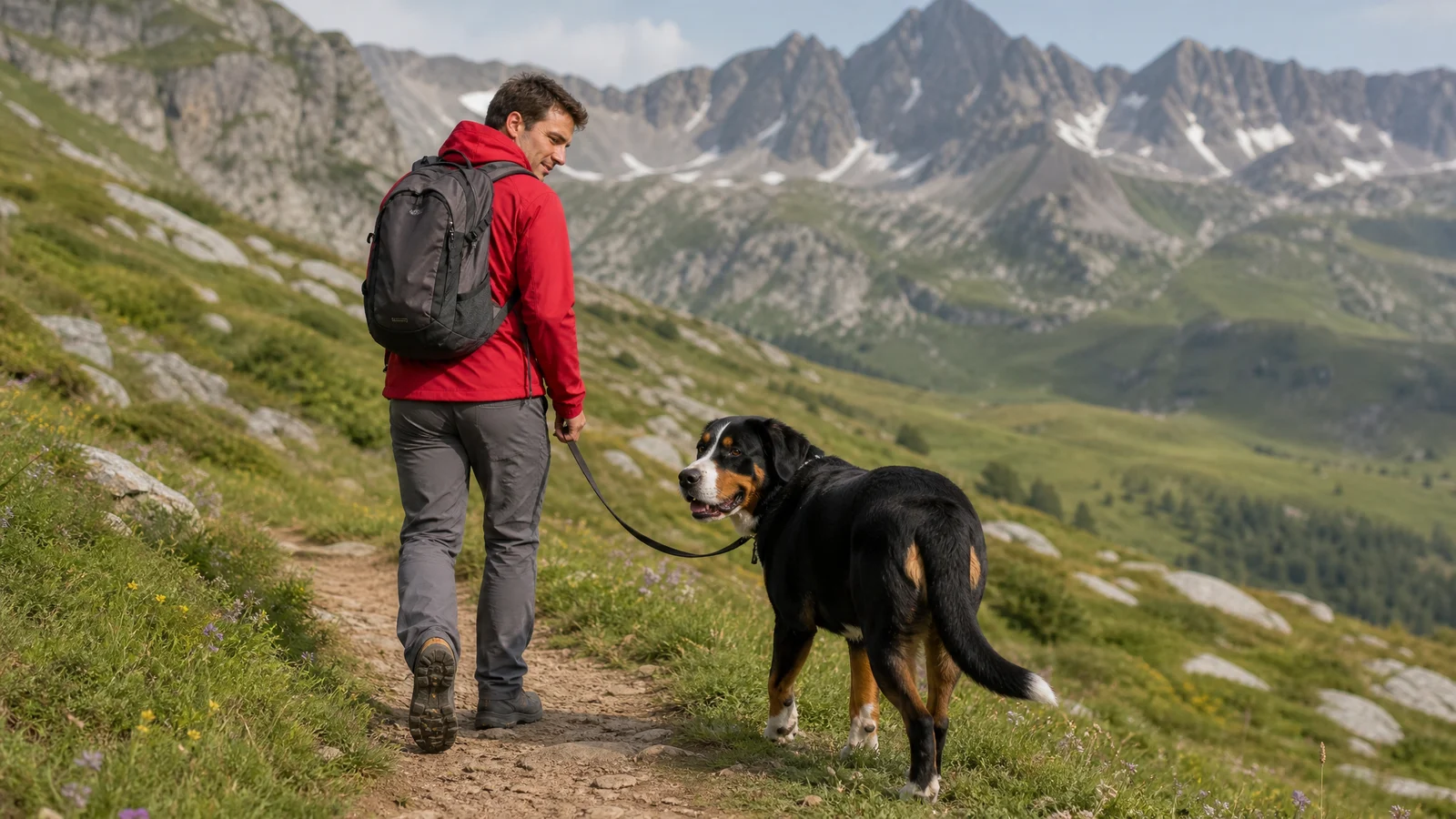
Trail enthusiasm does not solve every trail problem. A Greater Swiss Mountain Dog may still need help with a crowded parking area, a hiker with poles, an approaching dog, uncertain footing, or rising heat. Distance alone does not fully describe that work.
This guide uses scenario cards that can be rehearsed in any order. We will practice a busy arrival, a narrow pass, a scent interruption, a weather change, and a calm exit. Each card has a setup, a response to reward, and a reason to leave. The goal is not to complete every card on one hike, but to recognize the situation early enough to make a safe choice.
Scenario Practice for Greater Swiss Mountain Dog Hiking Training
Teach the pieces on ordinary ground before asking for them on a trail. Loose-leash movement, a hand target, a brief pause, and a broad turnaround can be practiced on sidewalks and quiet park paths. Add grass, gravel, shallow steps, and stable wood as separate surface questions.
Use the equipment planned for hiking during those rehearsals. The Swissy should move freely as the route curves and narrows. Inspect fit before and after practice. A pack stays outside this plan unless suitable guidance supports introducing one.
Create a distinct exit phrase. Say it during an easy walk, turn in a broad curve, and reward when the dog follows. The cue should predict a familiar route away, not appear for the first time after the dog is already alarmed.
Choose a trail with room to turn around and conditions that match current preparation. Weather, footing, and crowding can transform the same location between visits. A familiar short path with options often provides better training than a long route with no escape.
Keep the Scenario Cards Independent
Rehearse the cards with the same words you will use outside. A turnaround cue that changes every week will not create a dependable exit. Consistent language lets the surroundings vary while the dog’s route back to the handler remains familiar.
Each scenario card is independent. If the parking area is quiet, you may never use the arrival card. If footing changes early, the weather and surface card can end the outing before recall practice begins. That flexibility is the point.
The breed club includes hiking among its organized activity interests, which may help families find breed-aware community. Swissies who enjoy other outlets can explore dog sports through separate foundations.
Greater Swiss Mountain Dog Hiking at a Busy Arrival
Trailheads stack cars, doors, people, equipment, and dogs into a small area. Move to a quiet edge before adjusting gear. Reward the Swissy for observing activity and returning attention, then decide whether the path is still a suitable next step.
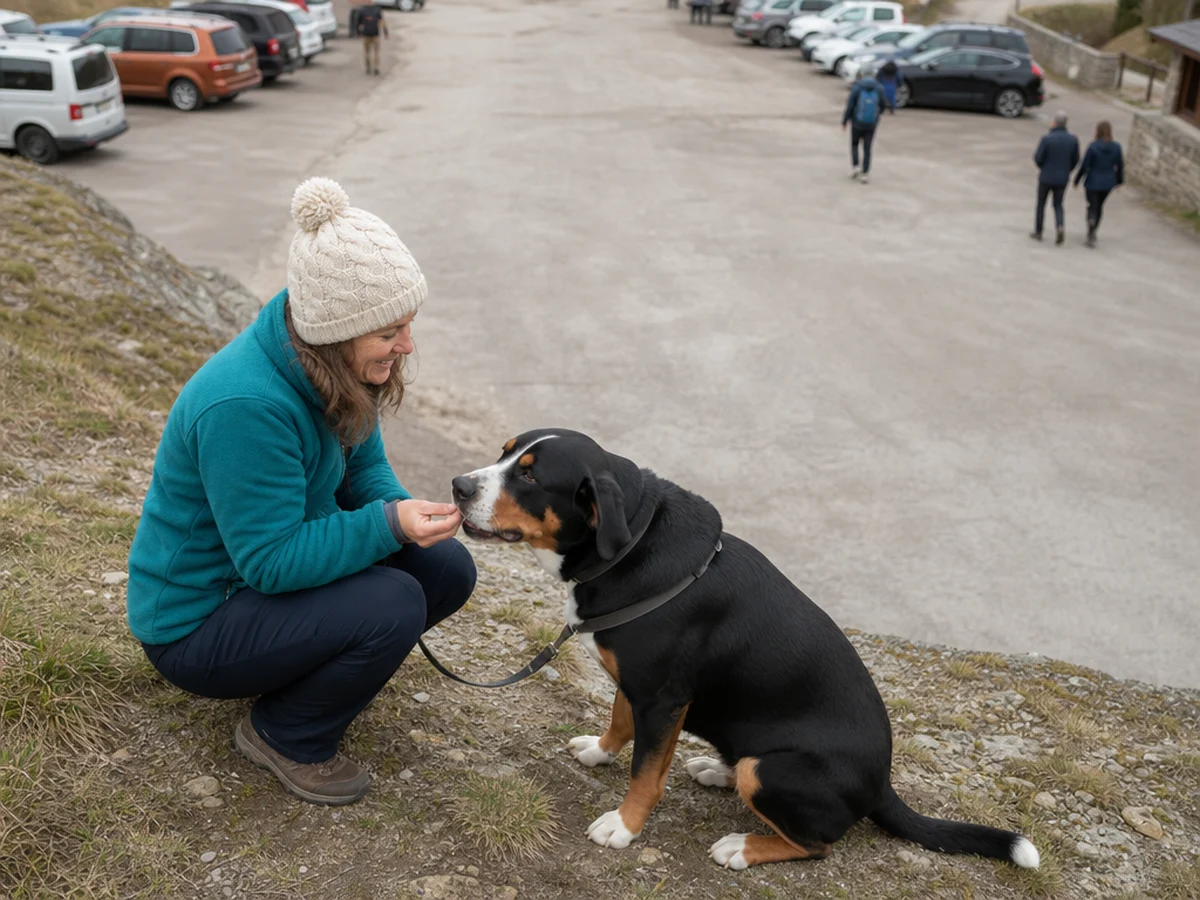
When food and an easy cue both lose relevance, move to a quieter edge with more space. Walking directly into the trail would add difficulty without adding skill. A pause outside the traffic flow gives both of you time to read the situation.
PDSA guidance advises keeping a dog on leash when recall is uncertain or distractions may be too strong. A busy arrival is a practical place for that conservative decision. The leash protects the setup while attention develops.
Watch the quality of the first several steps. A Swissy may orient at the car and then surge as the trail entrance comes into view. If that happens, return to the quiet edge, reward a shorter departure, and choose whether the arrival card needs to end the hike.
Begin forward movement only after the dog can orient and walk without dragging. Access to the trail rewards that response. If tension returns, pause in the wider area rather than carrying the struggle onto a narrow path.
Narrow Trail Passes Need Three Hiking Plans
Teach a side position on a wide path before using it around strangers. The dog can stand beside you or just behind your leg as long as footing is secure and the leash remains organized. Reward short duration, then release to sniff.
A Person Passes on Stable Ground
Start with a familiar helper. Step aside where the surface is level, cue the position, and deliver food low while the person walks past. Release the Swissy after the helper clears the space. Sniffing can make the brief wait worthwhile.
Add poles, bags, or unusual movement only after an ordinary pass is easy. Do not recruit strangers into practice. They should be able to continue without touching, feeding, or waiting for the dog.
Another Dog Requires More Distance
Communicate early when a dog appears. Turn around, move into a safe wider area, or wait where the Swissy can think. A trail is not the place to test a close greeting. Reward calm observation and movement with you.
If leash tension rises, create distance before asking for a target or turn. Pulling the dog close by force does not teach the passing position. Space keeps the plan reward based and prevents the encounter from becoming a contest.
An Unstable Edge Cancels the Pass
Do not step onto loose, steep, or cramped footing simply to let someone squeeze by. Use the exit cue and continue to a wider place, or reverse direction. The trained behavior serves safety only when the ground supports it.
A successful pass is not measured by closeness. It is a calm choice that preserves balance and leaves enough attention for the dog to resume. Sometimes the best pass occurs after both teams create substantial distance.
A Scent Interruption Tests Recall Training
Recall on a hike begins with a leash or suitable long line, not an off-leash gamble. Best Friends guidance recommends building the response on leash and using a longer line as skill improves. Use it only where the terrain allows safe handling.
The scenario starts when the Swissy notices a mild scent but remains able to respond. Say the cue once, move backward, and reward arrival generously. When appropriate, release the dog to investigate again. Returning need not end every interesting moment.
| What Happens | What It Tells You | Next Choice |
|---|---|---|
| Immediate turn and comfortable arrival | The setup is currently workable | Reward and repeat later, not immediately |
| Glance followed by renewed sniffing | The distraction competes strongly | Shorten distance and simplify |
| No turn toward the cue | The cue is unavailable here | Use the line as a boundary and move away |
| Arrival with slow recovery | The whole setting may be too difficult | Choose the exit card |
If the cue receives no response, prevent farther access without jerking the line. Move closer, reduce the distraction, and create an easy repetition later. Repeating the word until it becomes background noise weakens the information.
The RSPCA recall guide emphasizes not telling a dog off after they return. Even a delayed arrival should remain safe. Adjust the next context instead of making the finish unpleasant.
Reward voluntary check-ins at bends, clearings, and surface changes. Those moments show remaining attention before you need a formal cue. A predictable check-in can also precede a route decision without turning the whole hike into recall tests.
Weather and Footing Change Swissy Hiking Training
Pace is not a fixed mileage formula. Age, conditioning, health, heat, surface, and current response all matter. Compare the Swissy’s movement and recovery with the beginning of the outing rather than with a planned landmark.
Heat Makes the Exit Earlier
The source material identifies heat tolerance as a breed consideration. Favor cooler conditions, shade, and an early return option. Enthusiasm cannot prove that the dog is unaffected. The person must make the conservative decision before willingness becomes a reason to continue.
Pause on stable ground and allow actual rest. Offer appropriate water and observe breathing, posture, and movement without drilling cues. Resuming should depend on comfort, not on how close the group is to a destination.
Changed Movement Ends the Training Question
Turn around for hesitation, slipping, repeated stopping, changed gait, or slow recovery. Skip harder surfaces on the way back. The purpose of the card is to identify a change early, not to prove that the Swissy can push through it.
Maintain regular veterinary care, especially when growth, age, or a new movement change affects activity. This guide cannot determine medical readiness. It can make observations easier to notice and describe.
For a broader plan, compare Swissy exercise. Hiking is one outlet among everyday movement, recovery, enrichment, and training. It does not need to supply everything in one trip.
The Exit Card Finishes Greater Swiss Hiking Training
Use the exit card when gait changes, attention disappears, weather shifts, footing deteriorates, or trail traffic removes needed space. Say the familiar phrase, turn along the simplest safe line, and reward the dog for following. The destination no longer matters.
A turnaround is not a failed hike. It shows that the handler read the current scenario and protected the next one. Avoid adding challenges on the return, and let familiar loose-leash movement carry the team back.
At a safe stopping point, use a short decision list rather than a distance target. The answers should describe the current outing.
- Is the Swissy moving as comfortably as near the start?
- Can they still respond to one familiar cue around ordinary activity?
- Does the return route remain suitable for current weather and footing?
- Is there enough space to manage a pass without conflict?
- Would leaving now support an easy recovery after the outing?
The exit phrase should also work on ordinary walks when nothing went wrong. Occasional easy use prevents it from predicting only the end of an exciting outing. Reward the turn, travel briefly, and sometimes resume the original direction when conditions are suitable.
Observe transitions on the way out. Notice whether leash slack returns after sniffing, known surfaces remain easy, and the dog can pause without surging. These details will be more useful next time than the farthest point reached.
Afterward, record which card appeared, the setup, the response, and how readily ordinary behavior returned. Keep the note factual. “Followed exit cue after pole hiker appeared” helps with route choice, while “bad around hikers” erases distance and recovery.
End with one decision about the next outing. You may repeat the same quiet route, rehearse a person pass in a park, or choose cooler conditions. Scenario practice succeeds when the Swissy can respond comfortably and the person remains willing to play the exit card.
 Exercise and jobsHow Much Exercise Does a Greater Swiss Mountain Dog Need?
 Exercise and jobsBrain Games and Mental Stimulation for a Swissy
 BehaviorTeaching a Greater Swiss Mountain Dog to Be Good With Kids