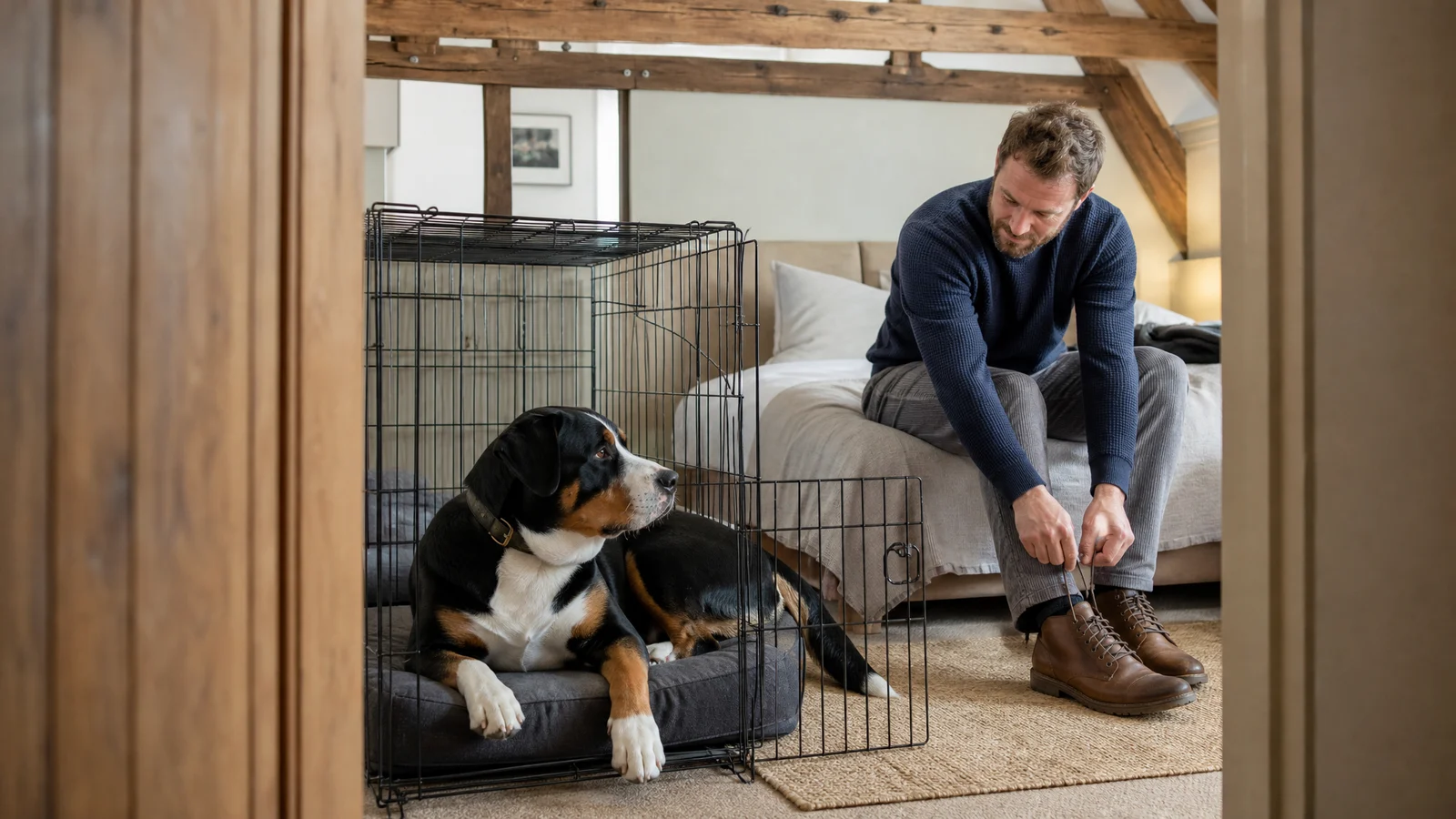
Walking willingly into a crate does not prove that a Greater Swiss Mountain Dog feels comfortable when a person leaves. Another Swissy may nap alone in an open room but object when the crate door moves. Those are different skills. Treating them as one ladder makes it hard to know which change caused discomfort.
Below, we work across six decisions. We separate the two questions, build the rest station, test door movement, test human distance, combine only easy evidence and route true distress to professional help. Video review stays inside the combination decision, so silence never substitutes for loose muscles, ordinary eating, normal orientation and the ability to resume rest.
Separate the Two Greater Swiss Mountain Dog Crate Training Questions
The first question is whether the crate itself predicts comfort. The dog should be able to enter, turn, lie in a natural position and leave through an open door. Food can begin the association, but relaxed body movement and voluntary return provide better evidence than eating alone.
The second question is whether the dog can remain comfortable as human distance changes. A family-oriented dog may follow a person from room to room even without a crate. The AKC's breed description calls the Greater Swiss Mountain Dog faithful, family-oriented and dependable. That description supports planning gradual distance, not assuming every dog will struggle.
Make a small chart with a door column and a distance column. After each session, record the exact door position, the person's location and what the dog did between food deliveries. Avoid a single rating such as good or bad because it hides which axis changed.
Keep regular veterinary visits current. Pain, digestive trouble, urinary needs, health changes and sleep disruption can all change crate behavior. Ask the veterinarian before beginning if the dog has a history of panic, injury during confinement or a sudden change in tolerance.
The Greater Swiss Mountain Dog Club of America's breed overview presents the Swissy as a versatile family or working canine. A crate can support rest and travel, but versatility does not make prolonged confinement appropriate. The station should serve daily life rather than replace movement, company and care.
Build a Greater Swiss Mountain Dog Crate Training Station
Choose a crate that allows the dog to stand without crouching, turn without folding the body and rest in a natural position. Check fit again during growth. A setup that suited a puppy can become cramped before the household notices.
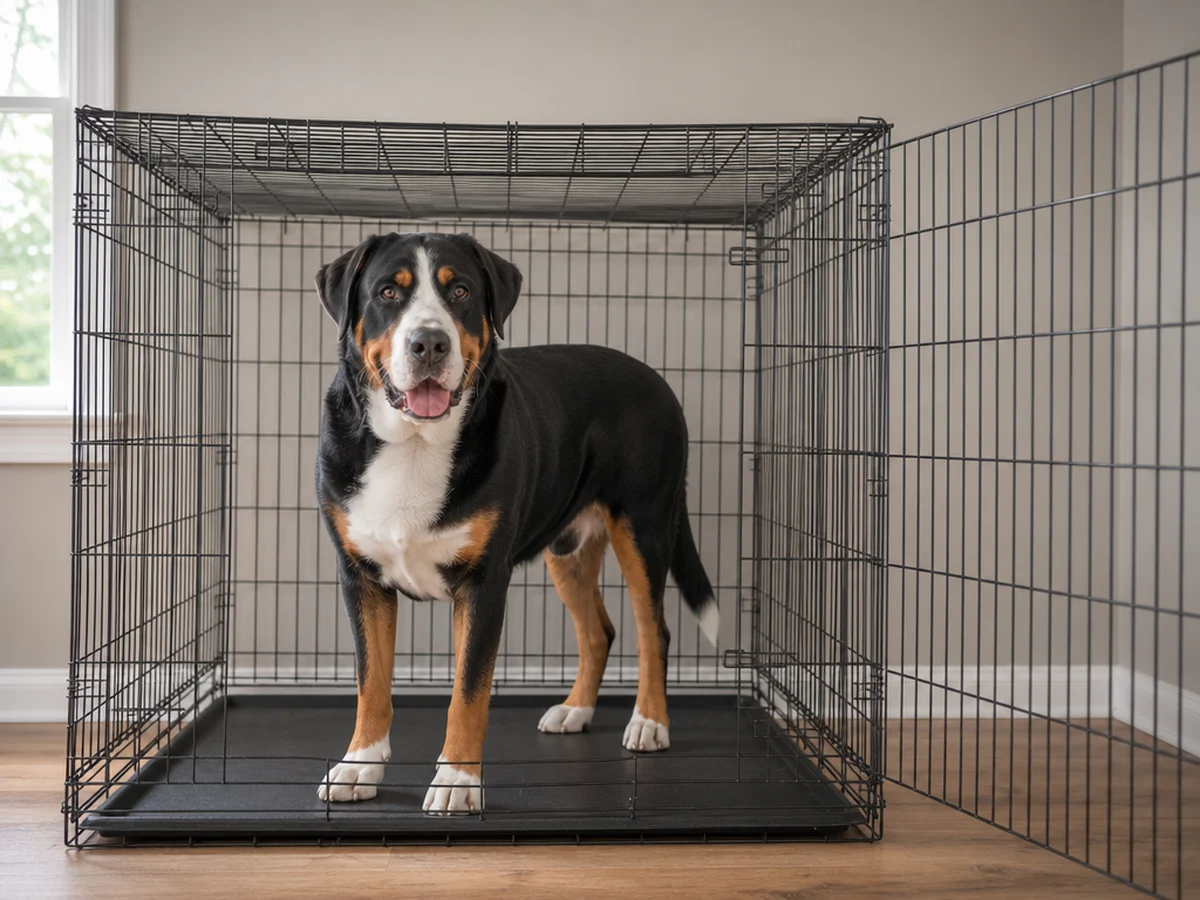
Place the crate on secure flooring where household activity is visible but traffic does not crowd the entrance. Prevent rocking and rattling. Leave enough clearance for the door to move fully without striking furniture, and keep cords, fabric edges and unsafe objects outside reach.
Temperature matters for a large, dark-coated dog. Avoid direct sun, heaters and stuffy corners. Provide water according to veterinary guidance and choose bedding that the individual dog can use safely. A dog who chews bedding needs a different setup from a dog who settles on it.
Begin with the door fixed open. Place a few pieces of the dog's ordinary food near the entrance, then farther inside. Let the dog leave after each visit. Do not reach in to hold the dog or use body position to block the exit.
AVSAB's training statement explains that reward-based teaching can still use structure, routine and clear guidelines. Here, the structure is a predictable station, brief sessions and one changed variable at a time.
Look for voluntary returns after food is finished. A dog who steps in, turns comfortably, pauses or lies down is beginning to use the station. A dog who stretches forward while keeping back feet outside needs easier placement and more freedom to investigate.
Test the Greater Swiss Mountain Dog Crate Door Axis
Keep the person seated beside the crate throughout door-axis work. The person does not stand, cross the room or disappear. Only the door changes, so any response can be interpreted without guessing about distance.
Door Movement With Immediate Reopening
When the dog is comfortable inside, move the door a small distance and deliver food. Open the door fully before the dog shifts toward the exit. Repeat until the movement becomes ordinary, then increase the arc slightly in a later repetition.
Progress includes loose muscles, easy eating, looking away from the door and choosing to remain after reopening. Pausing food, leaning forward, staring at the latch or turning abruptly toward the exit means the door change was too large.
A Closed Door With a Nearby Person
Close and reopen the door smoothly while staying beside the crate. Build a brief closed period by delivering food at a calm pace, then open while the dog remains comfortable. The opening should not wait for visible worry.
Change either duration or door mechanics, not both. A latch sound can be a new event even when the door position looks familiar. Practice the sound with immediate reopening before adding a longer closed period.
The RSPCA's crate guidance recommends short sessions and attention to signs that training moved too quickly. The correct response to concern is an easier repetition, not a test of endurance.
Test Human Distance in Greater Swiss Mountain Dog Crate Training
Fix the crate door open for distance-axis work. Begin only after the dog can rest or work on a safe food item while a person sits nearby. The person changes position, but the dog retains the ability to leave.
Movement Within the Same Room
Shift in the chair, stand and sit, or take one ordinary step before returning. Give food in the crate after the movement. Keep gestures natural and small so the dog learns that human motion does not always begin a departure.
If the dog follows, no mistake occurred. Reset with a smaller movement and reward the next choice to remain. The open door protects choice while the person discovers how much movement the dog can currently handle.
Brief Changes in Visibility
Move behind a partial visual barrier and return before the dog rises. A doorway edge or tall piece of furniture can create a small visibility change without a full absence. Increase the hidden moment only when the dog continues the same relaxed activity.
Practice ordinary departure cues separately. Pick up keys, put them down and sit. Open an interior door, close it and remain home. These actions should become poor predictors of a long separation before they are combined with crate closure.
Use the site's Swissy potty training plan to schedule bathroom opportunities around practice. A young dog who needs to eliminate cannot provide useful evidence about emotional comfort.
Combine the Two Greater Swiss Mountain Dog Crate Training Axes
Do not combine the hardest door result with the hardest distance result. Start one level below the dog's comfortable edge on both axes. A briefly closed door with a person one step away may be enough for the first combined session.
| Door result | Distance result | Next practice |
|---|---|---|
| Open door feels easy | Person crosses room easily | Keep door open and add a tiny visibility change |
| Brief closure feels easy | Person stays beside crate | Repeat closure before adding distance |
| Brief closure feels easy | One step feels easy | Combine the easier version of each |
| Either result causes concern | Evidence is mixed | Separate the axes and reduce difficulty |
A combined practice is ready to grow when the dog can eat normally, shift position, look away from the person and resume rest. Silence alone is not enough. A silent dog can still be rigid, alert and waiting for the door to open.
Increase only one feature in the next session. Add a little distance while keeping closure brief, or keep the person nearby while extending an easy closed period. Alternating the axis being changed keeps the chart readable.
Before a real departure, confirm the conditions below. Every item should match the dog's current evidence rather than the household's hoped-for schedule:
- The dog has had an appropriate bathroom opportunity and ordinary care.
- The station remains physically comfortable and safe.
- Both axes have produced relaxed evidence on separate days.
- The planned absence is shorter than the dog's demonstrated comfort.
- A camera is positioned to show the whole dog and the crate entrance.
A crate should never become an all-day holding place. Arrange care that matches the dog's age, health and current ability. The household schedule must adapt to the dog rather than forcing training to catch up with a fixed workday.
Read Crate Training Evidence on Video
Record practice and review the first minutes without relying on sound alone. Watch breathing, posture, orientation to the exit, ability to eat and changes in movement. Note the first moment behavior differs from the relaxed baseline.
A dog who finishes food and immediately scans the room may not be ready for a longer absence. Food can occupy the mouth while concern is building. The useful evidence is what happens during and after the food.
Record what the person did just before the change. The latch, footsteps, an exterior door or fading household sound may be the actual predictor. Return to the relevant axis and rehearse an easier version of that specific event.
Do not lengthen every successful session. Mix easy repetitions into the week so the dog does not learn that each entry becomes harder than the last. End some sessions with the door open and the person nearby.
The site's Swissy training guide can help coordinate food rewards and household cues. Keep the crate chart separate so progress in another skill does not substitute for evidence about confinement or distance.
When Greater Swiss Mountain Dog Crate Training Needs Professional Help
Stop increasing difficulty if the dog pants without heat, drools, paces, vocalizes persistently, refuses familiar food, eliminates despite an appropriate schedule or tries urgently to escape. Repeated distress is not a crate-training stage to work through.
Contact the veterinarian to rule out medical contributors and discuss the behavior. Share video, the two-axis chart and the timing of the first change. A veterinarian can help distinguish a setup problem from distress that needs an individualized plan.
If closing the crate intensifies worry, use a safe alternative area recommended by the veterinarian or qualified behavior professional. Do not assume tighter confinement will create security. The right environment is the one in which the dog can remain physically safe while the care plan proceeds.
The practical goal is not a Swissy who tolerates every combination. The aim is a dog whose door comfort and human-distance comfort are both understood. When the household keeps those axes separate, progress can be repeated, setbacks can be traced and alone time grows from evidence rather than hope.
 CareNail Trims and Paw Checks for Greater Swiss Mountain Dogs
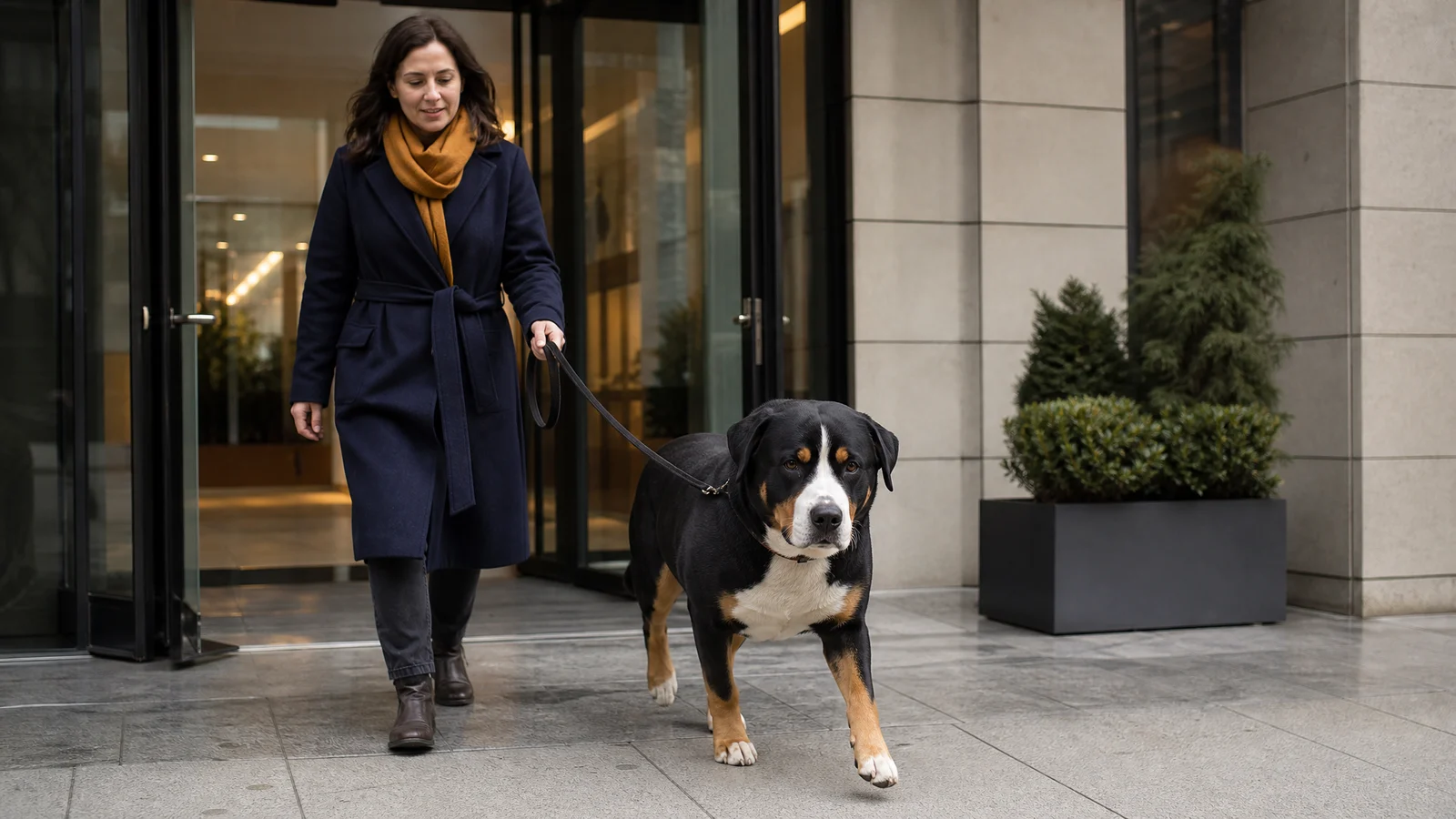 Training basicsTraining a Swissy for Apartment Living
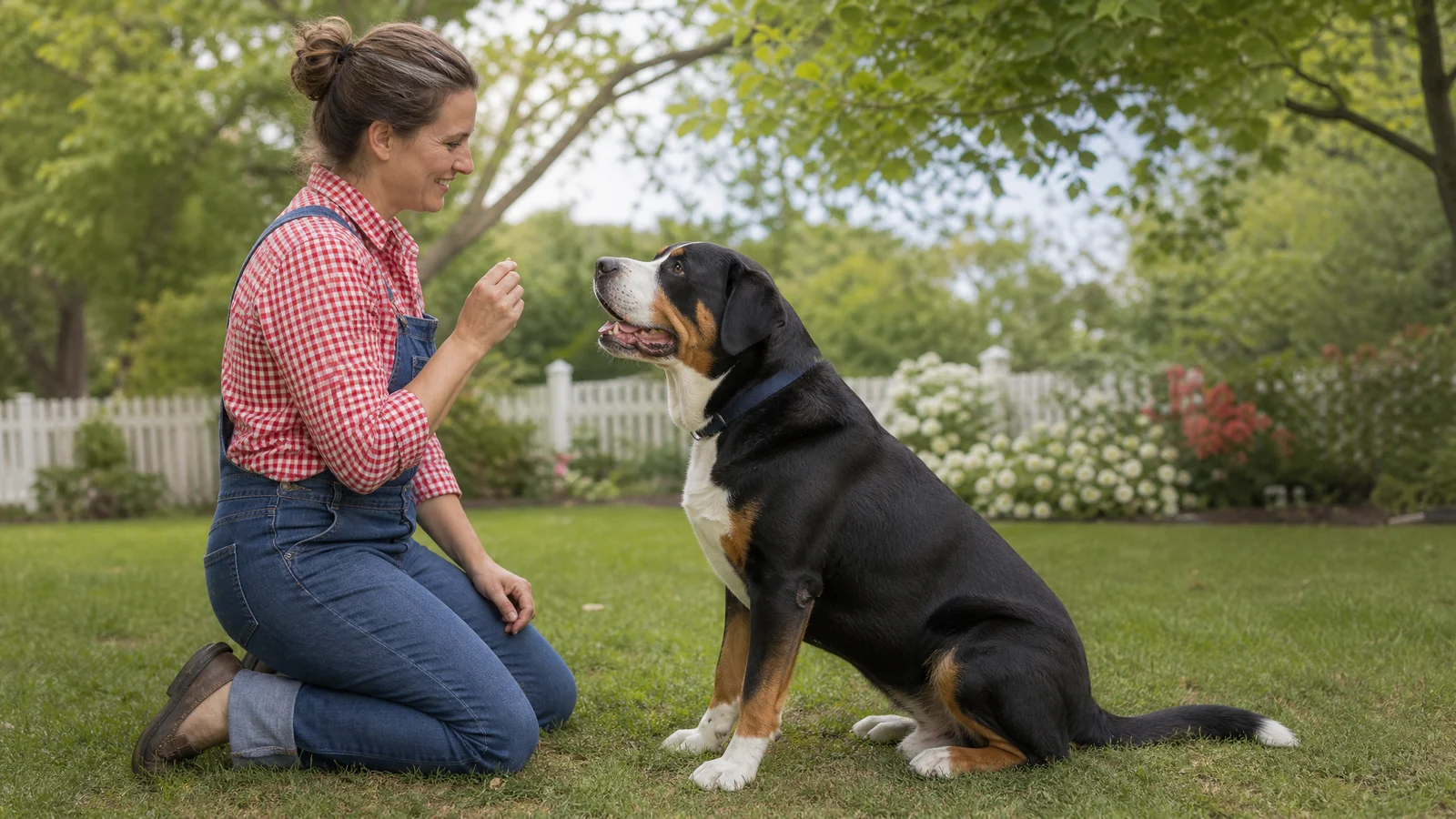 Training basicsAre Greater Swiss Mountain Dogs Stubborn or Easy to Train?