

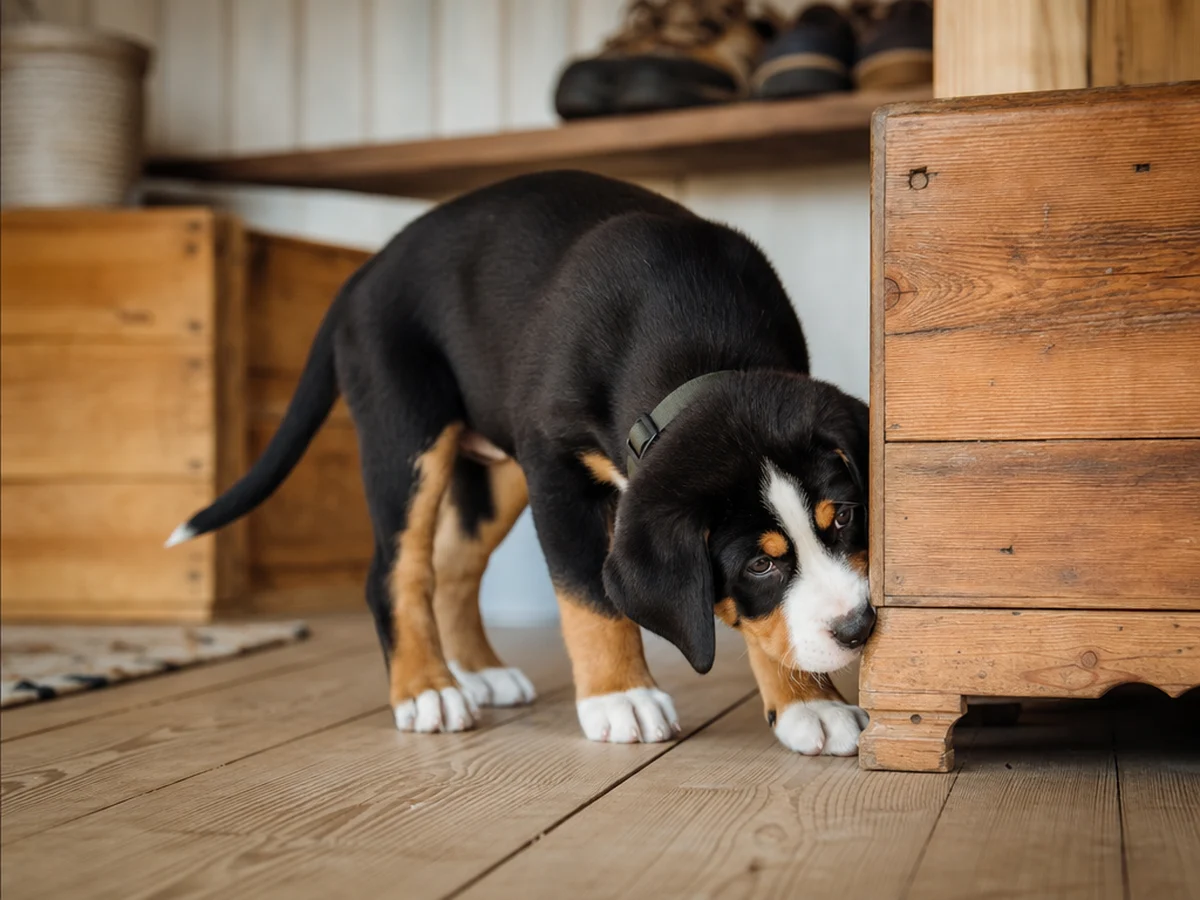
Household materials can become projects for a Greater Swiss Mountain Dog puppy long before adult judgment develops. A young Swissy can reach a table edge, carry a substantial object and damage a surface in a quiet minute. Chewing is normal exploration, but the size of the puppy changes the practical stakes. A chair rung, rug corner or shoe can become a rewarding project in a quiet minute.
Below, we move through five distinct jobs. We build a varied material library, map room risk, practice exchanges and supervision without a chase, identify evidence that points beyond ordinary chewing, and revise the library as the puppy grows. Ingestion, pain or absence-linked distress leaves the training lane and goes to the appropriate veterinary or behavior professional.
Build a Material Library for Greater Swiss Mountain Dog Puppy Chewing
Puppies investigate with their mouths, especially during developmental changes and quiet periods after activity. Chewing is natural, and many dogs continue to enjoy chewing throughout life. A lasting chewing interest is not proof that training failed. The household still needs suitable choices even after the puppy stops sampling every unfamiliar surface.
The useful question is what the puppy keeps selecting. Soft fabric, springy rubber, fibrous wood and cool hard surfaces each provide different feedback. When every legal object has the same texture, the household has not offered a real alternative to the varied materials already available.
Body size matters because a sturdy-looking puppy item can become too small or break down as the Swissy grows. The AKC official standard describes a draft and drover breed with a substantial appearance. Choose every object for the individual puppy's current mouth, chewing style and ability to remove pieces, not for a breed label on packaging.
Keep regular veterinary visits current and ask about safe chewing choices for the individual puppy. Teeth, gums, digestion, diet and growth can change what belongs in the library. A sudden increase in chewing, reluctance to eat or sensitivity around the mouth deserves veterinary attention.
Match Legal Choices to the Materials the Puppy Seeks
A material library is a small set of legal objects selected for different jobs. Each item earns a place by being easy to supervise, appropriately sized and interesting to the puppy. Remove anything that cracks, splinters, frays into swallowable pieces or becomes small enough to lodge in the mouth.
Soft Carrying Materials
Some puppies want to carry and mouth rather than settle for sustained chewing. Offer a large washable item designed for dogs and supervise the first uses. A good carrying choice stays whole, does not shed filling and can be picked up without inviting the puppy to steal laundry.
Store that object near the room where socks or towels attract attention. Reward the puppy for choosing the legal carrier before a forbidden item is collected. Placement matters because a perfect alternative in a closed cabinet cannot compete with a shoe on the floor.
Flexible Working Materials
A flexible object can support licking, food searching and steady jaw movement. Use part of the puppy's ordinary food when filling an appropriate food toy, and include that food in the daily diet. Check the object after each session for deep cuts or loose pieces.
These objects fit transitions such as settling after a walk or resting while the household cooks. Give the item before the puppy starts sampling furniture. The timing teaches a routine instead of using the object only after trouble has begun.
Firm Supervised Materials
A puppy who seeks wood or hard edges may prefer greater resistance. Ask the veterinarian which firm materials are suitable, then supervise continuously. Hardness is not automatically durability, and an object that never bends may be inappropriate for teeth.
Watch the style of use. Steady surface work is different from trying to split and swallow pieces. End the session while the item remains intact, record what the puppy preferred and inspect both the object and the mouth.
Cooling and Soothing Materials
Some puppies return to cool surfaces during periods of mouth sensitivity. A veterinarian can suggest safe options that fit the puppy's health and stage of development. Avoid improvising with household objects that become brittle, sharp or small.
Cooling is one feature, not a cure for every chewing bout. Pair the object with a quiet place and observe whether the puppy settles. If mouth discomfort appears persistent or interferes with eating, move the question from the library to the veterinary clinic.
Map Household Materials Before Greater Swiss Mountain Dog Puppy Chewing
Walk through each room at puppy eye level and list tempting materials. Then decide whether to remove the item, block access, cover the surface temporarily or place a legal match nearby. Management prevents practice while the puppy is still learning what each room offers.
| Material zone | Access change | Legal match | Training moment |
|---|---|---|---|
| Entry and shoes | Use closed storage | Soft carrying object | Reward carrying past the entry |
| Living room edges | Block unsupervised corners | Firm supervised object | Settle beside a person |
| Kitchen fabrics | Lift towels and mats | Flexible food object | Begin before food preparation |
| Work area cords | Route behind a barrier | Quiet licking choice | Practice during short desk periods |
The map should reduce choices, not create a bare room. Provide a resting surface, water and legal objects in the supervised area. Rotate only enough items to restore interest while keeping familiar options available.
Use the site's Swissy training guide when space is limited. Gates, furniture placement and predictable rest zones can separate the puppy from tempting materials without isolating the puppy from normal household life.
Review the map after visitors, deliveries or cleaning. A bag placed on the floor can change the room instantly. Every caregiver should know where temporary items go before the puppy enters.
Practice Puppy Chewing Exchanges Without a Chase
An exchange teaches that a person's approach predicts a useful outcome. Begin with a legal object that the puppy likes but can release easily. Approach calmly, present food near the nose, mark the release with a consistent word and give the object back when safe.
A good exchange trades a forbidden item for an appropriate toy or a tasty food reward, then adds a release cue after the pattern is familiar. Practice with legal objects first so the cue is learned outside an urgent moment. Several easy repetitions build a history that helps when the discovered object matters more.
Keep the rehearsal simple enough that the puppy stays relaxed. Each step should preserve an easy release before the list continues:
- Offer a legal object and allow a brief period of chewing.
- Bring food to the puppy instead of calling from across the room.
- Say the release word once as the mouth opens.
- Deliver the food, inspect the object and return the object when safe.
- End after a few easy exchanges while the puppy still wants to participate.
Returning the object is important during practice. If every release permanently ends access, the puppy may learn to move away faster. When the object cannot be returned, trade for another legal choice and guide the puppy to that choice.
Do not pursue a puppy around furniture. Chasing can add play and possession value. Close a door or use an existing barrier to reduce space, scatter food away from the item when safe, then collect the object after the puppy has moved.
Supervise Puppy Chewing Without Constant Conflict
Active supervision means noticing the puppy before the mouth reaches a forbidden surface. Choose short windows when one person can watch, keep a legal object within reach and redirect at the first approach. Outside those windows, use the room map and a safe rest area.
Match chewing to the daily rhythm. A puppy may need a calm object after play, a food-filled option during household activity and a carrying object during greetings. The related Greater Swiss Mountain Dog exercise guide helps caregivers count activity and recovery across the whole day.
Record the material, place and time of repeated choices. A pattern near dinner may call for an earlier settling routine. A pattern after missed rest may call for a quieter environment. A pattern in one room may be an access problem rather than a lack of exercise.
Give children a clear rule to call an adult rather than reach for an object in the puppy's mouth. Adults should manage the space and run exchanges. This protects both the relationship and the practice sequence.
Progress appears as faster selection of legal objects, easier exchanges and longer periods in which the puppy rests near available household materials. It does not require the puppy to ignore every tempting item without management.
When Greater Swiss Mountain Dog Puppy Chewing Signals Another Problem
Contact the veterinarian promptly if the puppy may have swallowed part of an object, shows pain, vomits, cannot pass stool, stops eating or has a sudden behavior change. Do not wait for a training rehearsal to solve a possible medical issue.
Damage that happens only when people leave needs a separate assessment. Panting, pacing, vocalizing, drooling or frantic damage around exits can indicate distress linked to absence. The ASPCA's distress signs support shortening absences to a level the dog can handle while professional help is arranged.
Use a camera to observe the first part of an absence if the puppy is safe. Note when behavior changes and what happens before damage begins. Do not assume a damaged doorframe is ordinary teething or deliberate misbehavior.
For persistent chewing that resists careful management, ask the veterinarian for a qualified professional. Battersea's professional roles distinguishes skill teaching from assessment of behavior problems. Share the room map and material log so the professional can see the pattern.
Maintain the Greater Swiss Mountain Dog Puppy Chewing Library
Review each library item as the puppy grows. Retire objects that have become small, damaged or easy to dismantle. Add material variety only when the new choice can be supervised and inspected, then record whether the puppy uses the object as expected.
Keep exchanges alive after the intense puppy stage. Brief, easy practice protects the release cue for future discoveries. Continue storing high-value household items away rather than testing whether training can defeat unlimited access.
The long-term goal is a Swissy who moves toward familiar legal materials, releases objects without conflict and can settle while ordinary household items remain out of reach. Chewing may remain enjoyable throughout life. A thoughtful library turns that normal need into a routine the household can support instead of a contest the puppy must lose.
 Training basicsCrate Training a Greater Swiss Mountain Dog Without Anxiety
 CareNail Trims and Paw Checks for Greater Swiss Mountain Dogs
 Training basicsTraining a Swissy for Apartment Living