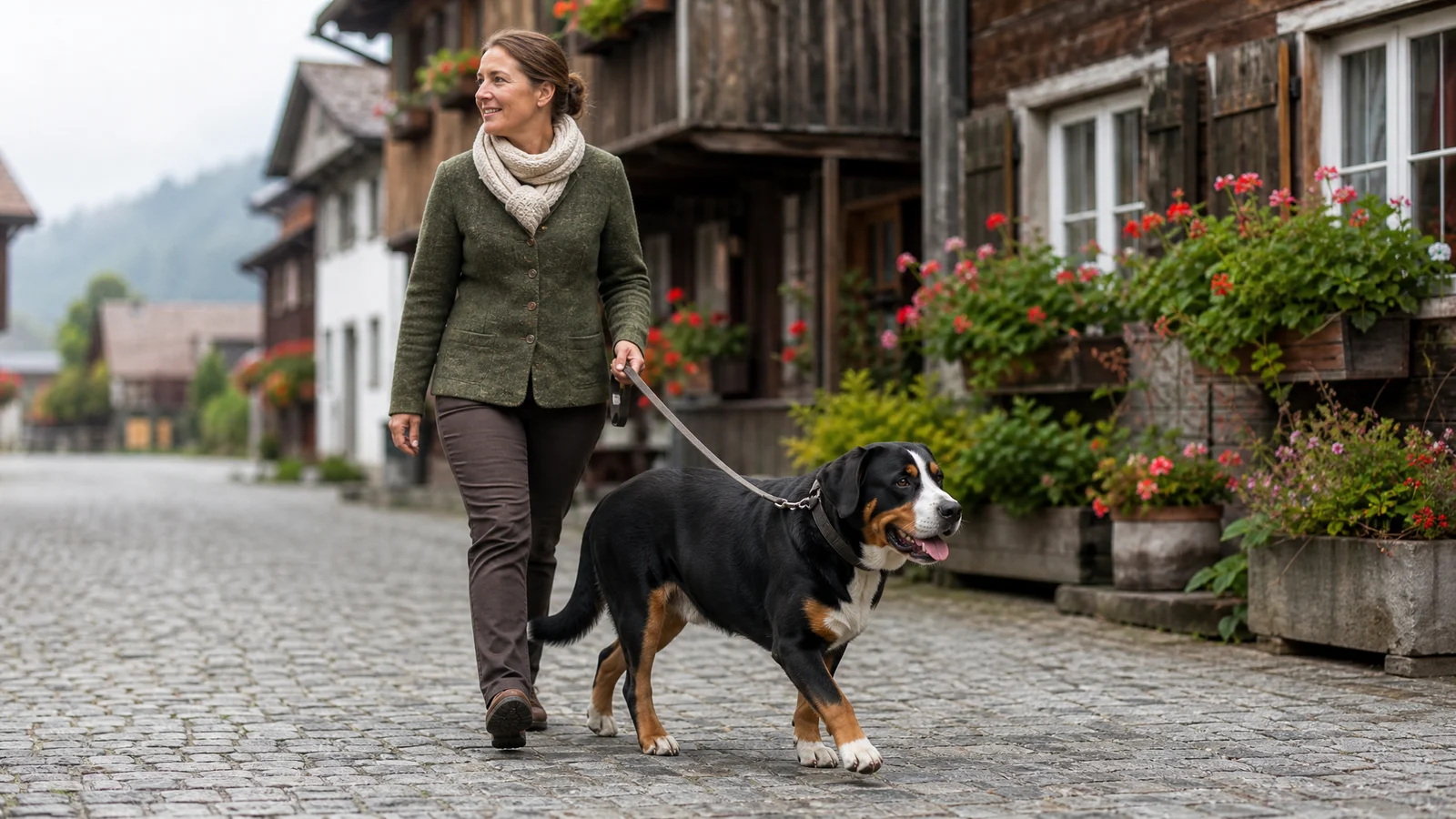
The first useful decision happens when the leash tightens. You can keep moving and let tension carry the walk forward, or you can pause before a powerful Greater Swiss Mountain Dog learns that pulling opens the route. That choice matters more than trying to overpower the dog after momentum has already built.
Below, we work through a nine-stop route rather than repeat one loose-leash drill. We separate pulling from lunging, fit equipment, map pressure points, teach the driveway, practice the first corner, choose one of two trigger exits, assemble an ordinary walk and review the map. Each stop answers a different decision the walker must make before the leash is fully tight.
Pulling and Lunging in Greater Swiss Mountain Dog Leash Training
Pulling usually has a destination. The Swissy leans forward, reaches the end of the leash and keeps pressure on while trying to reach a smell, corner or familiar person. If forward travel continues, the route itself rewards the effort.
Lunging is a faster change. The dog may stiffen, stare, accelerate or spring toward something nearby. The goal may be social access, investigation or more distance. The same movement can have different emotional causes, so the handler needs to observe before choosing the next step.
Watch the whole sequence, not only the loudest second. A pulling episode may begin when the pace rises across several yards. A lunge may begin with a closed mouth, forward weight and a fixed look long before the leash snaps tight.
- Record the first change and its location. That lets another walker respond at the same point instead of debating the dog's motive after momentum builds.
- Record workable distance. Note where the dog noticed the trigger, whether food still mattered and whether the body could turn away.
- Pay before bracing. The site's guide to Swissy temperament explains why food motivation and an independent pause can coexist, so rewards must arrive early enough to influence a choice.
Choose Greater Swiss Mountain Dog Leash Training Equipment by Fit
Equipment should fit the individual dog, stay comfortable during movement and remain manageable for the person holding it. Check the skin beneath contact points, watch the shoulders while walking and confirm that clips and straps cannot shift into a position that pinches.
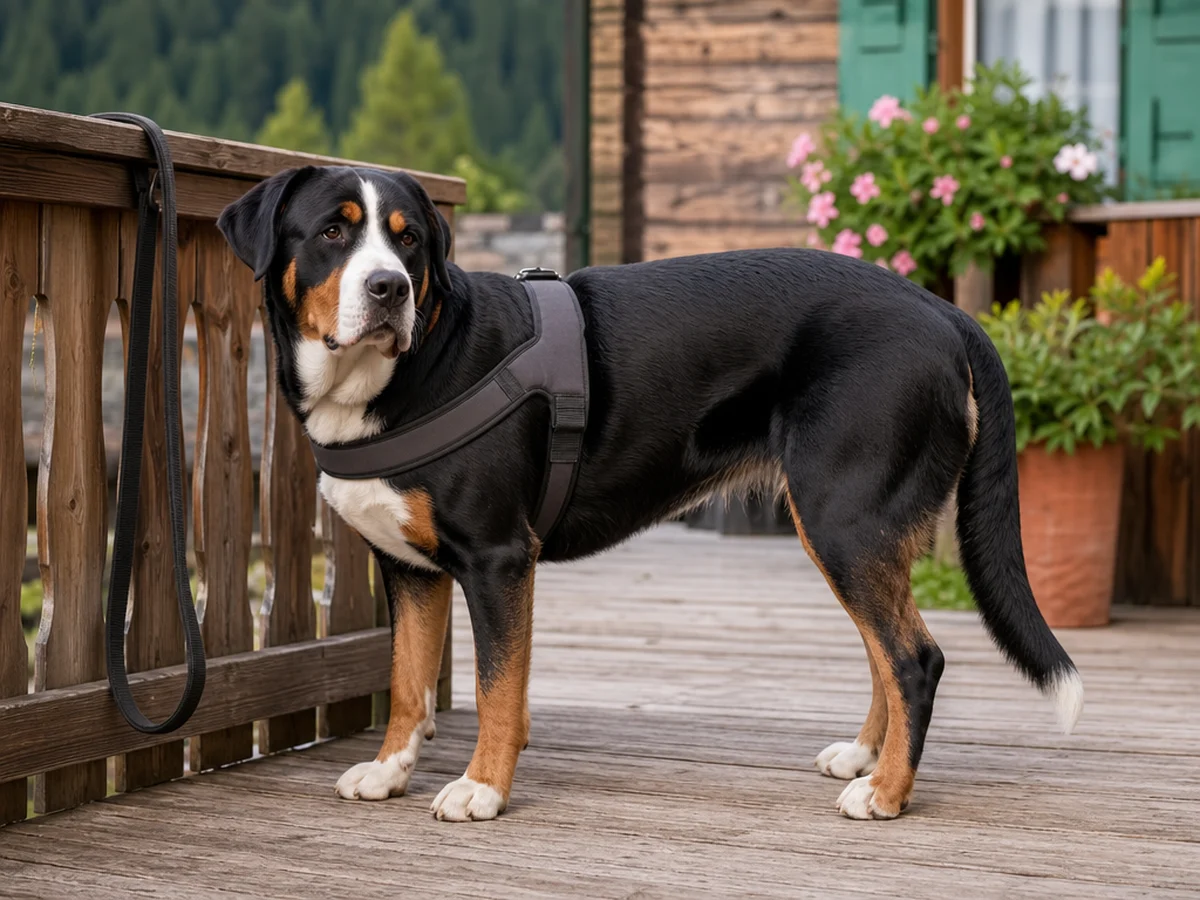
The AKC breed profile cautions that a harness-type training device may encourage this draft breed to pull harder. That breed-specific warning does not make every harness harmful, and it does not make another tool teach loose-leash walking automatically.
Fit and teaching answer different questions. Comfortable equipment protects the body, while food and access explain which walking choices pay. Judge the dog's movement in the chosen setup, then teach a soft leash instead of expecting hardware to create the behavior.
A standard leash that lets the handler gather length without wrapping it around a hand is useful for ordinary practice. Before leaving home, rehearse holding rewards, marking the correct moment and changing direction with smooth hands. Human handling should be predictable before the route becomes difficult.
Test the setup in a secure, quiet place. The walker should be able to shorten or release working length without dropping food, tangling the line or bracing against the dog. If the mechanics feel rushed indoors, simplify them before adding the street.
Recheck fit as a puppy grows and whenever movement changes. Keep regular veterinary visits in the larger plan, and ask the veterinarian about new tenderness, an altered stride or reluctance that appears with ordinary walking.
Map Pressure Points in Greater Swiss Mountain Dog Leash Training
Walk the route once as an observer. A pressure point is any location where the dog predictably speeds up, braces, scans or loses the ability to respond. Marking those places turns a vague complaint about the whole walk into several smaller training decisions.
| Location | What appears first | Easier arrangement |
|---|---|---|
| Driveway | Fast launch toward the street | Start after a calm pause inside the property line |
| First corner | Leaning toward familiar smells | Reward before the turn and take a wider arc |
| Narrow sidewalk | Staring or rushing past others | Cross early or wait in a wider space |
| Home stretch | Pulling toward the door | Pause before the final approach and reward slack |
The map is allowed to change. Parked vehicles, trash collection, school dismissal or weather can alter the useful distance. Treat the current environment as part of the lesson rather than proof that yesterday's skill disappeared.
Add an exit to every marked location. A driveway may offer a return to the yard, while a corner may offer a wide turn onto a quieter block. Knowing the exit before tension rises lets the walker move decisively without dragging the dog through a crowded space.
Time belongs on the map too. The same sidewalk may be workable early and crowded later. Compare like with like before deciding that training improved or failed, then schedule practice when the dog can still notice rewards and recover easily.
Choose one easy pressure point first. If the driveway is manageable but the narrow sidewalk is not, teach at the driveway and manage the sidewalk. Training does not require testing the hardest location on every outing.
Teach Leash Training Slack at the Driveway and First Corner
Begin where the dog can notice the handler and still eat comfortably. Stand still with enough leash length for a neutral posture. Mark a glance back, a shift toward you or any softening of tension, then place the reward beside the leg you want the dog to return near.
Take one or two steps and mark slack before the dog reaches the end. If tension appears, become still without drawing the leash backward. The PDSA loose-leash lesson uses the same pause, followed by a reward when the line softens.
Forward movement can become part of the reward. When the leash softens, take another step toward the smell or corner the dog wanted. This makes the rule practical: slack moves the walk, while pressure pauses it.
Reward placement should support the next step. Food beside the walker encourages a return to shared space, while permission to sniff can reward several connected steps. Alternate these rewards so the dog does not stare at a hand or rush toward every expected food delivery.
At the first corner, begin the turn before the leash reaches full length. Mark the dog for following the arc and deliver the reward after both bodies have changed direction. A broad turn gives a large dog room to organize without a sudden pull across the shoulders.
The First Corner in Greater Swiss Mountain Dog Leash Training
A marker can sharpen timing if it already predicts food. Battersea's clicker basics pairs the sound with a prompt food delivery before using it in training. A spoken marker works too when it is brief and consistent.
Repeat only while the dog and handler can stay organized. A short success at the first corner teaches more than a long contest through several pressure points. Return home or switch to a simpler sniffing area before fatigue makes leash handling rough.
Distance becomes the training decision around triggers. A trigger changes the priority from position to workable distance. If the Swissy has stopped eating, cannot turn or keeps weight pressed forward, move away. Asking for a polished sit beside the trigger does not create calm when the dog is already beyond a useful learning point.
Approach-Seeking in Greater Swiss Mountain Dog Leash Training
Social interest can still produce unsafe lunging. Let access depend on a loose body and slack leash, and remember that the other person or dog does not owe a greeting. If arousal climbs, turn away and reward following before deciding whether any approach should resume.
Use parked cars, driveways or a wide curve to keep space. Mark the moment the dog notices the trigger without surging, then deliver food where turning back toward the handler is easy. Several calm observations at a distance are more useful than one close encounter that ends in a lunge.
Distance-Seeking in Greater Swiss Mountain Dog Leash Training
A worried dog may lunge to make something leave. Food should not draw the dog nearer. Increase distance, place your body away from the dog's line of travel and reward the choice to follow you toward safety.
Practice an exit cue on quiet walks so it is familiar before a difficult encounter. Say the cue, turn through open space and reward after the dog comes with you. The exit should feel like a familiar route change that begins before barking or lunging.
After an encounter, give the dog room to decompress. A calm sniff in open space or a quiet return home can be more useful than immediately testing another pass. Recovery speed belongs in the record because it helps set the difficulty of the next outing.
Join Leash Training Skills Into an Ordinary Walk
An ordinary outing can contain training, management and free sniffing. Label those parts for yourself. Train slack at the driveway, manage distance through the narrow section and allow relaxed exploration where the route opens.
Before each pressure point, pause long enough to inspect the setup. The following three questions keep the decision focused on what is happening now:
- Can the dog notice the walker and use food here?
- Is there enough room to stop or leave without a struggle?
- Will moving forward reward the behavior happening now?
If any answer is no, change the setup. Cross the street, wait for space, shorten the route or finish in an easier area. Good leash training includes decisions that prevent a rehearsal, even when no formal cue is practiced.
Do not make every outing a concentrated lesson. Some walks can use a quiet route with generous sniffing and only a few rewarded transitions. That balance protects the handler's timing and prevents the dog from meeting an endless stream of requests.
Share the map with anyone who walks the dog. The site's food-reward Swissy training guide can help household members use the same marker and reward delivery. Consistency at the pressure points matters more than matching a perfect heel everywhere.
Review the Map and Choose the Next Leash Training Change
Review the route after several walks. A location is improving when the first sign of tension appears later, the dog can turn away more easily or slack returns with less help. Record the location and response, not only whether the walk felt good or bad.
Sudden reluctance to walk, a new uneven gait or discomfort under equipment deserves veterinary attention. Repeated lunging that puts people at risk calls for a credentialed professional who uses reward-based methods and can observe the dog and environment directly.
Ask the professional to work from the route map rather than staging a close encounter for demonstration. Find the distance where the Swissy can observe, follow the walker and settle afterward. That starting point supplies useful evidence without rehearsing the strongest response.
Tomorrow, choose one marked pressure point and make it easier before you leave. Start farther away, arrive at a quieter time or reward before the usual pull begins. A workable route grows from those location decisions, one patch of loose leash at a time.
 BehaviorGreater Swiss Mountain Dog Jumping on Guests: Rewarding Calm Hellos
 BehaviorWhy Does My Swissy Bark and How Do I Teach Quiet?
 Puppy trainingPacing Exercise for Greater Swiss Mountain Dog Puppies Who Grow Fast